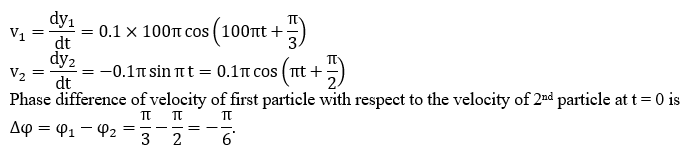
Two simple harmonic motions are represented by the equations  and
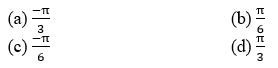
and  The phase difference of the velocity of particle 1 with respect to the velocity of particle 2 is
Text Solution
Verified by ExpertsThe correct answer is:
C
Prepare Smarter with CGP Edu
Get practice questions, solutions, and test series in one place.
Write a Review
Share your experience with this question and solution.
Commentary
Send your comment, doubt, correction, or feedback to admin.
Similar Questions
Explore conceptually related problems
A particle starts S.H.M. from the mean position. Its amplitude is A and time period is T. At the ti…
The amplitude and the periodic time of a S.H.M. are 5cm and 6sec respectively. At a distance of 2.5…
Two equations of two S.H.M. are and . The phase difference between the two is
The amplitude and the time period in a S.H.M. is 0.5 cm and 0.4 sec respectively. If the initial ph…
The equation of S.H.M. is , then its phase at time t is
A particle is oscillating according to the equation , where t is in second. The point moves from t…